Cities and outposts on the water
Embarking costs a flat 20 movement points. Any culture may found an outpost on a habitable water province, but only Mercantile may upgrade one into a city.
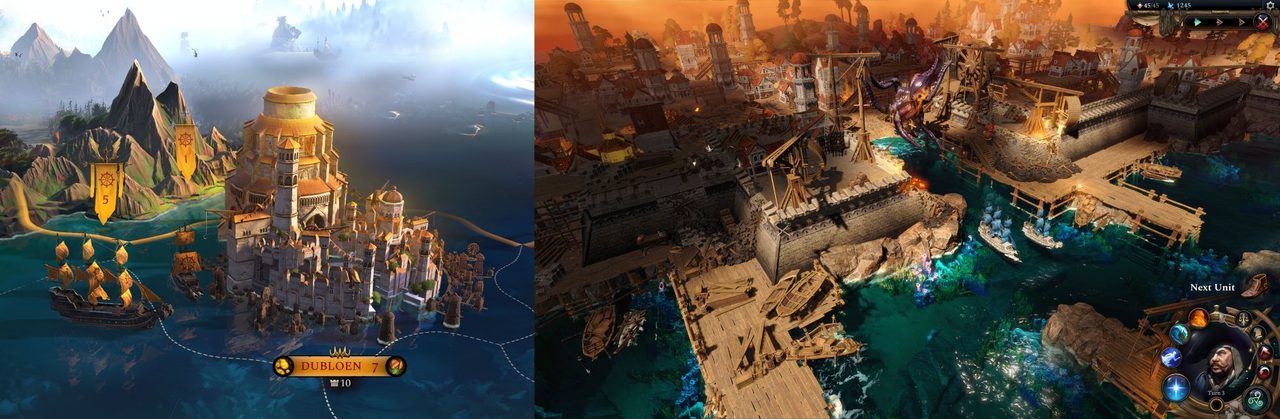
Before the Manta update, water was a surface you crossed and a place you could not stay. You could not found an outpost on it, you could not build most special province improvements on it, and embarking cost a unit its entire turn. All three of those rules changed on 3 November 2026, and the result is that the ocean is now settleable by everyone — just not equally.
The one asymmetry that matters is who can turn a water outpost into a city. Every culture can plant the outpost. Only Mercantile can upgrade it.
Three rules that changed
| Rule | Before Manta | After Manta |
|---|---|---|
| Embark cost | All movement points, minimum 12 | Flat 20 movement points |
| Water outposts | Not possible | Possible on habitable provinces with water in the centre |
| Upgrading a water outpost | Not applicable | Impossible, except for the Mercantile culture |
| Water province improvements | Very limited | Spelljammer, Beacon of Unity and Teleporter can be built on water |
| Vision on water | Embarked units only | Embarked and Aquatic units both get +2 vision |
That third row is why the culture exists. For a non-Mercantile empire a water outpost is a trade node and a staging point; for Mercantile it is the first step of a settlement.
The point of a water outpost
Even without the upgrade, water outposts are useful, and the Manta update made them more useful by reworking how outposts pay. An outpost no longer generates income on its own; it also no longer costs upkeep. Its domain income only reaches you if a city builds a trade route to it, at which point everything the outpost's domain produces — food, production, draft, node income — is added to that city.
That changes the calculation. You are not settling the sea for a small income; you are extending a city's domain across water and creating a node a route can connect to. Magic materials are gained by having them in your domain, route or not.
Once Mercantile upgrades it
A Mercantile water city is a real city: it grows, it builds, it can be specialised around trade, and it can be attacked and conquered. It also sits on water, which has consequences:
- It is hard to reach. Land armies have to embark, which costs 20 movement points, and embarked units are vulnerable in combat.
- It can run routes across open water, which the trade system says are almost always the most efficient paths between distant cities.
- It needs food. Water provinces produce less food than grassland, so a floating city depends on routes to outposts and Free Cities for growth.
- It can be raided from the sea. A city on water is reachable by any fleet, and its routes are reachable by any raider.
The practical build order
For a first floating city, the order that works is: found the outpost on a water province with a resource node or a magic material, connect it to your capital with a route, then upgrade it once Mercantile's city conversion is available. Do not upgrade before the route exists — an unconnected city on water is a food sink with a nice view.
The city's first buildings should be the ones that make routes cheaper or more valuable, not the ones that make units. A floating city's job is to be a hub; the army comes from somewhere with production.
If you are not Mercantile
If you are playing another culture, water outposts are still worth building, but treat them as logistics: a way to claim a magic material, extend a route, or park a fleet. Do not expect them to become cities, and do not spend a settler's worth of resources defending them.
The exception is Eternal Ice. Whiteout turns water into walkable ice, which means a non-Mercantile empire can cross to a water outpost without embarking at all, and can defend it with a normal army. It is the only other way to make the sea feel like territory.
Common mistakes
- Upgrading before connecting. A water city with no route starves.
- Settling the first province you see. Look for a node or a material; empty water is a bad city.
- Ignoring escorts. Every route can be raided, and a floating city's routes are the most exposed in the game.
- Forgetting the vision rule. Aquatic and embarked units both get +2 vision now, so a cheap aquatic scout sees further than it used to.
The trade routes page covers the connection rules in detail, the Mercantile culture explains the upgrade permission, and water combat covers what happens when someone comes for the city.
One rule that catches people out
Water outposts cannot be upgraded by anyone except Mercantile, but they can still be conquered. A non-Mercantile empire that takes a Mercantile water city keeps it, the restriction is on founding and upgrading, not on ownership. That makes a floating city a legitimate target for a neighbour who wants a naval base without playing the culture.
It also means a Mercantile player should expect their cities to be more attractive than their size suggests. A city on water is a forward base for anyone with a fleet.