Trade routes: the new economy
Routes cost draft scaled by distance in movement points, start at one per city, and pay differently by target: outposts 100%, Free Cities a share, foreign cities 20% gold and mana.
Trade routes are the biggest system the Manta update added, and the one most likely to change how you open a game. Before them, an outpost paid you automatically and cost upkeep. After them, an outpost pays nothing unless a city connects to it, and the connection costs draft.
Not a nerf, but a redesign of what an outpost is for. A route connects a city to an outpost, a Free City or another empire's city, and what you get depends on which.
Payout by connection type
| Target | Requirement | What you get |
|---|---|---|
| Outpost | None | Everything the outpost's domain produces: food, production, draft, node income |
| Free City | At least a Pact of Cooperation | A percentage of the Free City's income in all resources, based on what it produces |
| Vassalised Free City | Vassalage | Gold and Mana even without a route; a route adds every other resource |
| Another empire's city | Free Trade Agreement (requires a Wizard's Bond) | 20% of the target city's Gold and Mana income |
Magic materials work differently: you gain them by having them in your domain, with or without a route, though the node's income still travels through the route like everything else.
Capacity, distance, draft
Every city has a Trade Route Capacity that determines how many routes it can run at once. It starts at 1 and is increased by the core trade structures available at city tier 2, 3 and 4.
| Structure | Tier | Capacity | Other effects | Sub-structures |
|---|---|---|---|---|
| Trade Post | 2 | +1 | Stronger escorts; +5 gold per foreign-owned route into this city | Outpost Supply Hub (+50% outpost income) or Diplomatic Embassy (+5 Imperium per foreign route) |
| Trade Quarters | 3 | +1 | Stronger escorts; +10 gold per foreign route | Food Importers (+20 food, +10 stability per outpost/Free City route) or Wizard's Exchange (+10 Knowledge, +10 Mana per foreign route) |
| Trade Bazaar | 4 | +1 | Stronger escorts; +15 gold per foreign route | Caravaneer's Guild (+1 capacity, −20% draft cost) or Taxation Offices (+5 gold, +5 stability per route) |
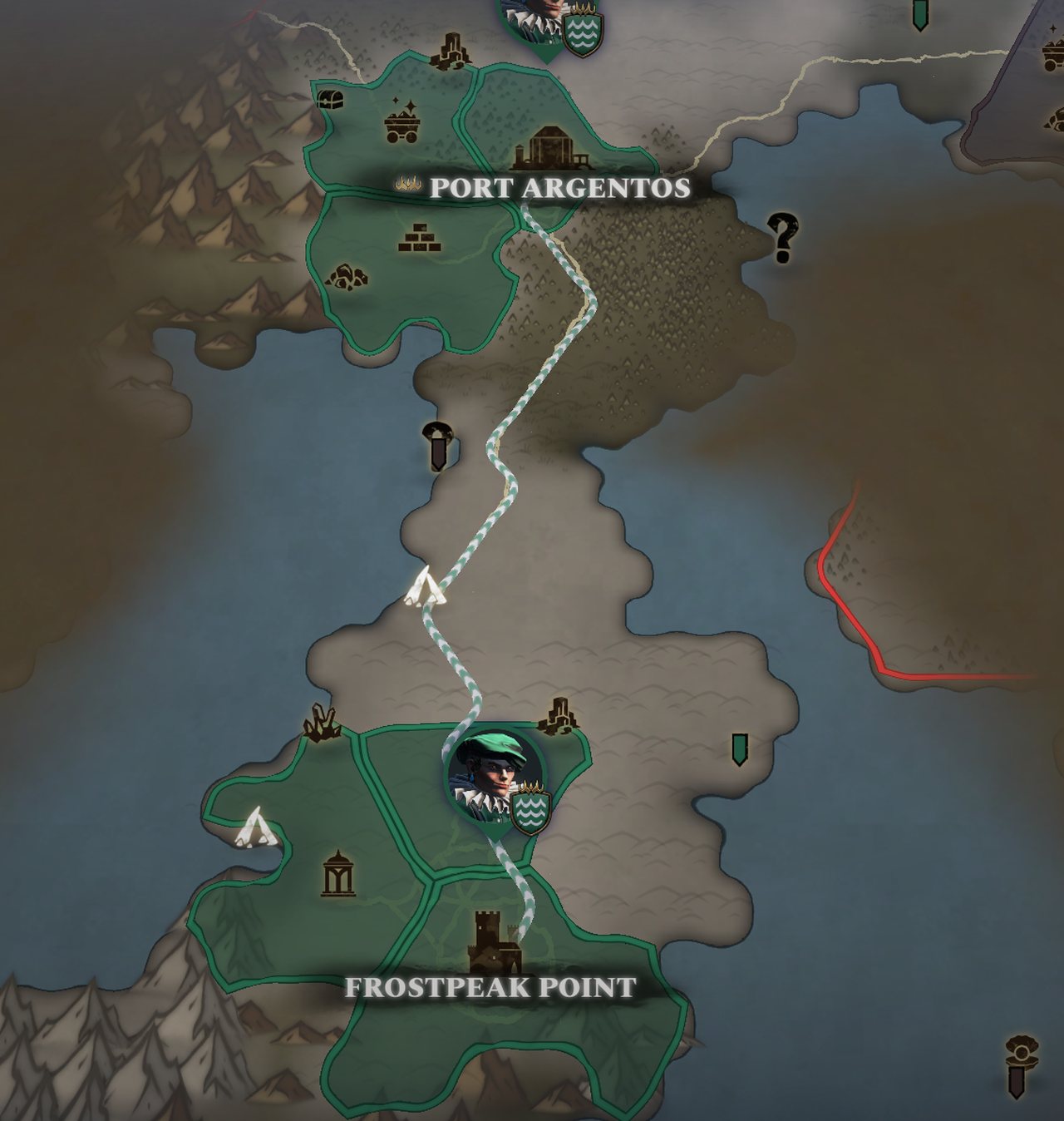
Route creation costs draft, and the cost scales with both the target and the distance. Distance is measured in movement points using a racial mock unit, which means a fast race gets cheaper routes on its preferred terrain. Water routes are almost always the most efficient, because the mock unit's water movement is generous, which is the mechanical reason the sea is worth settling.
Escorts and raiding
Every route has an Escort that fights for it when raided. Escorts are not strong enough to stop a real army, but they handle small raider bands and scouts, and their strength scales with the trade structures in the origin city.
Raiding is a wartime action. An army stands on a hex the route passes through, clicks raid, and fights a 1v1 battle against the escort with no reinforcements on either side. Surviving units keep their damage. A successful raid pays 3× the route's per-turn income, so the most profitable routes are the most attractive targets.
The Free Trade Agreement
The Free Trade Agreement is a bilateral agreement available between two empires that have at least a Wizard's Bond. It lets both sides build routes to each other's cities, and those routes pay 20% of the target city's Gold and Mana — less than a good vassal, but with no military commitment and no vassalage required.
The subtlety is that foreign routes also feed the origin city's own trade structures: a Trade Post pays gold for every foreign-owned route connecting to it, and higher tiers pay more.
Free City focus
Free Cities can be steered with Trade Focuses: you pay an Imperium upkeep to increase their output of one resource, which increases what the route passes on. Asking a Free City to focus Gold increases the proportion it passes along the route by 50%, and a vassal passes 65% of its Gold instead of 15%. An active route also improves your relation with the Free City, which speeds up allegiance.
Your opening, adjusted
- Build the route before the outpost pays. An unconnected outpost is a claim, not an economy.
- Take Trade Post early. The first capacity point and the +5 gold per foreign route are worth more than they look.
- Prefer water. Routes over water are cheaper for the distance they cover, which is the strongest argument for a coastal capital.
- Defend the profitable lines. A route paying 100 gold a turn is worth 300 to a raider.
The Mercantile culture is built on this system, the sea cities page covers outposts on water, and the Manta update lists the rest of the free changes.
One worked example
A coastal city with a Trade Post, a Trade District and three routes — one to an outpost, one to a Free City, one to a foreign capital — is doing four things at once. The outpost route passes on everything that outpost's domain produces. The Free City route passes a share of its output, boosted if you pay for a Trade Focus. The foreign route pays 20% of that city's gold and mana. And the Trade District pays a bonus for each of the three routes connecting to the city, while the Trade Post adds +5 gold for each foreign-owned route pointing at you.
The shape of a Mercantile economy: not one big number, but five small ones that all scale with the same decision — how many connections can I hold at once.